
Start here: Check whether your business clearly matches the service, where it appears across your market and how its reputation compares with nearby competitors. The map shows the pattern; the profile and website help you investigate it.
LOOK AT THE EXAMPLE
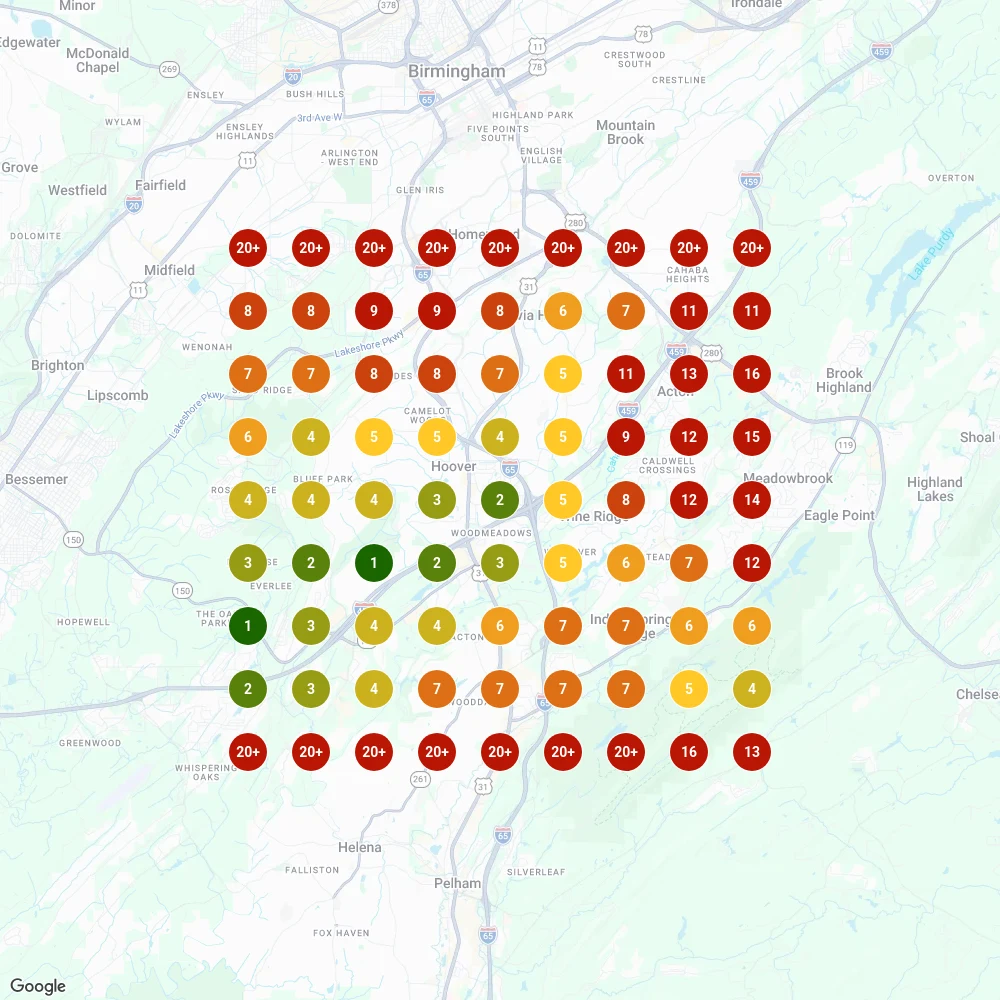
Read the center, then count the whole grid. The business ranked #2 at the center, but only 11 of 81 points reached the top three. This is the gap a single search from the office can miss.
Open the actual scanThe three local ranking factors
Relevance
Use accurate categories and service information so customers and Google can understand what your business does.
Distance
A location page can improve relevance, but it cannot override the searcher’s physical proximity to a business.
Prominence
Keep business listings accurate, invite honest customer feedback and pursue relevant local links.
FROM OUR RESEARCH
Great reviews. Still hard to find.
A strong rating helps a customer choose you. They still need to find you first. We check which services Google connects to your business, where you appear and who shows up ahead of you before deciding what to change.
US home-service prospect sample. Ratings of 4.5 stars or higher; completed selected-service scans, June 16 to November 13, 2026. How we checked the data
How to read this example

What you can control
Use accurate categories, helpful location content, and a maintained Google Business Profile to improve relevance. Keep citations consistent, build useful local authority, and earn reviews at a pace that reflects authentic customer volume, not a universal quota. Want hands-on help? Start here:
How to choose what to investigate first
Start with one important service and compare its results across your market. Use the pattern to decide which profile and website details to inspect.
Fix relevance when the match is unclear
If you rarely appear for a service you genuinely provide, check the primary category, services, page titles, service-page content, internal links, and whether the website clearly connects that offer to the location.
Measure distance instead of fighting it
If rankings are strong near the business and fade with every mile, proximity is probably shaping the result. Better location content can clarify relevance, but it cannot make a business physically closer to every searcher.
Build prominence when competitors are trusted more
If the service and location match but established competitors still win, compare reviews, citations, local links, brand mentions, website authority, and the quality of the customer experience before the click.
Patterns to investigate in your results
| What you see | Likely cause | What to review |
|---|---|---|
| You do not appear for a core service | Likely relevance gap | Review categories, services, dedicated service pages, titles, and internal links. |
| You rank near the office but not across the market | Distance and service-area pattern | Use a ranking grid, confirm the real service area, and strengthen useful location content without creating doorway pages. |
| You appear but stay below established competitors | Prominence or conversion gap | Compare review quality and recency, citation consistency, local authority, brand proof, photos, and landing-page usefulness. |
| Rankings vary sharply by keyword | Mixed intent or page targeting | Separate broad informational searches from service, emergency, location, and booking intent before changing the page. |
What Local Howl measures before recommending work
A useful review combines Google Business Profile accuracy, service and category coverage, rankings from multiple points in the market, citation consistency, review patterns, website structure, and the authority of the businesses already winning. That evidence helps distinguish a fixable relevance gap from a geographic limitation or a longer-term prominence problem.
Improve the details the review identifies, then measure comparable map results. Report received inquiries and booked work separately, using the tracking and business records available.
- Explore Google Maps SEO services
- Run a local competitor comparison
- Read the home-service implementation guide
How to investigate a local ranking gap
Start with a service you want more work from
Write down what a customer would search for, then check that it describes work you genuinely provide. Open your profile and the relevant website page. Can a customer quickly confirm that you offer the service, serve their area and have a way to contact you? Record missing or inaccurate details before making changes.
Check more than your own location
Run that search across a map grid covering your actual market. Keep the query and scan settings with the results. If positions are stronger near the business and weaker farther away, distance may be part of the explanation. If one service performs differently from another on the same grid, inspect how each service is represented. Neither pattern proves a cause by itself.
Use reviews in context
Our US home-service prospect sample found that 101 of 167 locations rated 4.5 stars or higher averaged under 10% top-three coverage across their measured searches. These completed scans ran from June 16 to November 13, 2026; ratings and scans may have different snapshot dates. That finding gives you a reason to check beyond the star rating. Compare the businesses appearing at weak points, including their actual services, reviews and useful website information. The sample does not identify which factor caused a gap.
Choose a change you can verify
If a core service is missing from the website, explain it accurately and make it easy to find. If profile details are wrong, correct them. Save what changed and when, then repeat comparable scans over time. Track received inquiries separately so you can distinguish visibility changes from business results.
What it actually takes to do this yourself
You’ll need to compare the search results with the information people can find about your business.
- Tools
- A grid rank tracker, a keyword tool with real search volume, and access to your profile’s performance data.
- Access
- Owner or manager access to the Google Business Profile, the website and analytics.
- Know-how
- Reading a grid scan alongside your profile, website and competitor information to investigate visibility gaps.
- Upkeep
- Reviewing changes in your business, competitors and search coverage so priorities stay current.
Where owners get stuck
- Choosing changes before checking the profile, website and competitor evidence.
- Judging coverage from a single search at your own business.
- Choosing keywords without checking demand or whether they match the work.
- Leaving the original plan unchanged as the business and competition change.
How Local Howl can help
Your program sets the scope. We’ll agree on who handles each task and how we’ll report it.
DO IT YOURSELF
You can confirm your services, update inaccurate details and ask genuine customers for honest reviews. Keep a simple record of changes and begin with the services that matter to your business. A grid tool becomes useful when you need a consistent view across several neighborhoods.
- Learn the three factors
- Set up comparable map scans
- Review your profile, website and competitors
- Choose the changes supported by the findings
- Make the changes and scan again
The research gives you priorities. The next job is making the changes and checking what happens.
WITH LOCAL HOWL
Knowing the ranking factors is the easy part. Working out what is holding your business back means comparing services, competitors, website pages and results across your market. We do that research, agree on the priorities and carry out the work covered by your program. You can see what changed and how we measured it.
- We check map coverage for searches that fit your services
- We review your profile, website and competitors to investigate gaps
- We handle the profile, website and listing tasks in your plan
- We explain changes in visibility alongside separately measured inquiries
Guidance checked November 18, 2026. Read the source: