What to expect from Local Howl
Start by confirming your business, services and service area. A scoped local review identifies verified problems and opportunities to investigate. We then agree which profile updates, listing corrections, service-page improvements and reporting are included. The free automated website report is a separate starting point, not a complete Maps audit.
- Baseline: record the services, exact search queries, search locations and dates. Retain grid settings so later scans can be compared.
- Priorities: identify the evidence for each finding, the recommended action and what still needs confirmation.
- Responsibilities: agree what Local Howl will implement and what requires your access, business details or approval. Record recommendations and completed changes separately.
- Reporting: compare consistent search conditions and explain the next action. Report visibility, received inquiries, qualified prospects and booked jobs as separate measures.
Paid ads, additional locations, website rebuilds and third-party costs are not automatically included. Confirm scope and billing terms in your proposal. There is no promise of a top-three position across every city.
Start with a Free Website AuditMost home-service owners do not wake up wanting "SEO." They want the phone to ring when a homeowner nearby searches for the exact thing they do: emergency plumbing, AC repair, roof repair, panel upgrades, gutter installation, remodeling, drain cleaning, or a trusted contractor near them.
The sections below explain the work to review with Local Howl: profile accuracy, listing corrections, genuine review processes, relevant service pages and repeatable Maps reporting. Use the deliverables and questions to decide which work your business needs before agreeing to a plan.
The short version: good Google Maps SEO services should improve your Google Business Profile, clean up business listings, strengthen reviews, support the right service pages, track rankings across the real neighborhoods you serve, and report on calls or leads. If the plan does not show you those pieces, it is probably too thin.

Keynote Speaker on Local SEO | Helping Local Businesses Unlock Google Maps
Nashville, TN
Connor works with local business owners and home-service operators on Google Business Profile visibility, local SEO audits, citation gaps, review trust, and Map Pack opportunities. This guide focuses on the questions home-service owners should ask about scope, reporting, and the work needed to improve local visibility.
Choosing a Google Maps SEO provider: Ask what the provider will review, which problems they will fix first, and how they will report progress. A useful plan should explain the work in plain language and connect it to the services and areas your business actually serves. Before signing, make sure you understand the scope, billing terms, and how inquiries will be tracked.
What are Google Maps SEO services?
Google Maps SEO services are the work done to help a local business show up more often and more convincingly in Google Maps and the Local Pack. For a home-service company, that means keeping business information accurate, improving relevant service-page content, and strengthening the local reputation that helps customers decide whether to contact you. Our home-service local SEO ranking guide explains how those factors fit together.
Google's own local ranking guidance says local results are mainly based on relevance, distance, and prominence. That matters because nobody can simply pay Google for a better organic Maps ranking. Google specifically says there is no way to request or pay for a better local ranking. The work has to improve the signals Google can actually evaluate.
For a home-service company, that means reviewing both ranking-related work and customer response:
- Your Google Business Profile: categories, services, service areas, business description, photos, reviews, posts, products where relevant, and conversion actions.
- Your website: service pages, location relevance, internal links, schema, helpful content, mobile UX, calls to action, and trust proof.
- Your citations and listings: correct business name, address, phone, categories, URLs, and duplicate suppression across important directories.
- Your reviews: volume, recency, wording, rating, owner responses, and whether real customers mention the services you want to rank for.
- Your authority: links, mentions, associations, sponsorships, suppliers, local press, and other proof that your business is known.
- Your customer response: Track calls, direction requests, and website clicks to understand how people interact with your listing. Treat these as engagement measurements, not confirmed Google ranking factors.
Why home-service companies buy Google Maps SEO
Home-service searches are not casual. A homeowner searching for an HVAC repair, leaking pipe, roof repair, electrician, landscaper, pest control company, or contractor is often deciding who to call right now. That makes Google Maps different from a normal informational search. The map result is not just visibility. It is a call path.
This is also where a lot of local SEO advice breaks down. A national ecommerce site can chase broad organic traffic. A service-area business needs to win in the neighborhoods and cities that produce profitable jobs. Ranking at your office is useful, but it does not prove you are visible in the ZIP codes where your best customers live.
That is why Local Howl's audit and reporting angle matters. A single rank check from one location can hide the problem. A local SEO competitor analysis and map pack grid can show whether you are invisible everywhere, strong near your base, or sitting just outside the top three in valuable neighborhoods.
Home-service takeaway: the goal is not to look busy in SEO reports. The goal is to find the searches and service areas where you are close enough to win calls, then push the right signals in those markets.
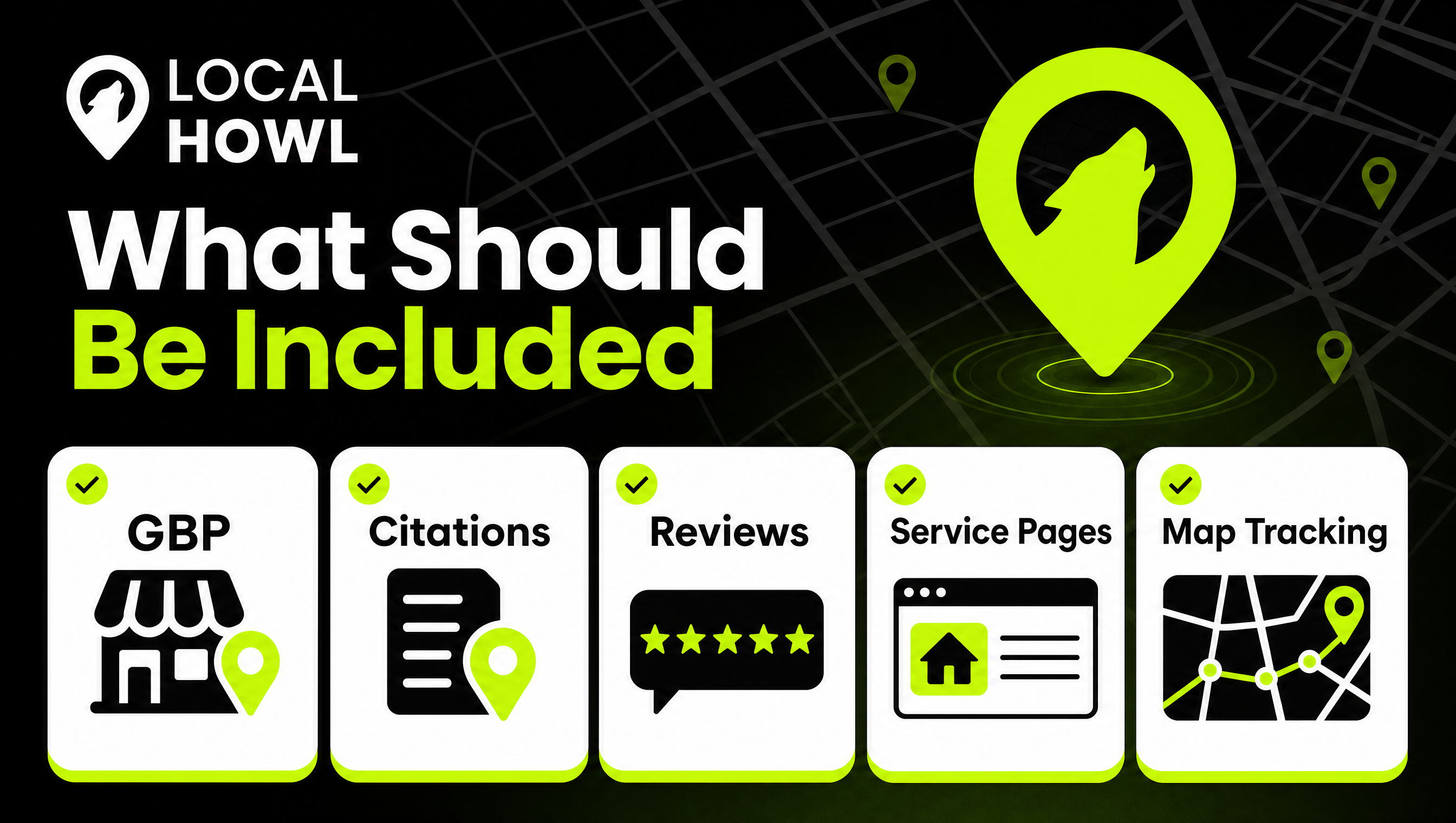
What should be included in Google Maps SEO services?
A strong Google Maps SEO plan should be specific enough that you can see the work. If a provider says "we optimize your profile" but cannot show you which categories, services, citations, pages, reviews, and tracking points they are working on, you are buying hope instead of a plan.
1. Google Business Profile optimization
Your Google Business Profile is the starting point because it is the entity Google uses inside Maps. A good Google Business Profile optimization service should review the primary category, secondary categories, services, service-area settings, business description, appointment links, photos, Q&A, posts, and profile completeness.
For home-service businesses, category and service alignment matters a lot. If you offer water heater replacement, sewer repair, AC repair, roof replacement, panel upgrades, or gutter installation, the profile needs to make that clear without stuffing keywords into places they do not belong.
2. Citation cleanup and business listings
Citations are mentions of your business details across directories, data providers, local sites, and industry platforms. Messy citations can make search engines less confident in your business. The basics are simple: your business name, address, phone number, website, categories, and service information should be consistent where it matters.
Local Howl already has a local SEO citation audit and business listings and local citations services for exactly this reason. For home-service companies, cleanup is often one of the first practical fixes because old addresses, duplicate listings, wrong phone numbers, and inconsistent categories can quietly weaken trust.
3. Review strategy and response support
Reviews do two jobs. They support prominence for Google, and they help a homeowner decide whether to call you. A review strategy should help you ask at the right moment, invite customers consistently without review gating, incentives or scripted language, respond professionally, and identify review themes that support the services you want to rank for.
Good review work is not just "get more stars." A useful review for a home-service company often mentions the actual service, the city or neighborhood, the technician experience, speed, communication, or the problem solved. That language helps humans first, and it can also reinforce relevance.
4. Service pages that support Maps rankings
Google Maps SEO is not only the profile. Your website helps prove what the profile claims. If your profile says you offer drain cleaning, roof repair, AC installation, panel replacement, or remodeling, your site should have real pages that explain those services clearly.
This is where local keyword research matters. A plumber does not need fifty generic blog posts. They need the right service pages, the right city or service-area support, helpful FAQs, strong internal links, image alt text, and clear calls to action.
5. Map Pack tracking and reporting
Reporting should show more than one rank number. A home-service company needs to know where it is visible across the service area. One neighborhood might be strong. Another might be one competitor away from the top three. Another might need a service page, reviews, citations, or stronger authority signals.
That is why Local Howl's local SEO tracking and reporting should be tied to real decision-making: what changed, where rankings moved, which services improved, and what should happen next.
Swipe sideways to read all three columns.
| Deliverable | What it should answer | Buyer red flag |
|---|---|---|
| GBP optimization | Is the profile clear, complete, accurate, and aligned with high-intent services? | "We optimized it" with no category, service, or photo notes. |
| Citation cleanup | Is NAP, category, and URL data consistent across important listings? | Hundreds of low-quality listings with no duplicate or accuracy work. |
| Review strategy | Are real customers steadily mentioning the jobs and markets you want to win? | Fake review language, incentives that break policies, or no owner responses. |
| Service pages | Does the website prove what your profile says you do? | Generic blogs with no improvement to money pages. |
| Map tracking | Where do you rank across the neighborhoods that create calls? | One rank check from your office or a generic traffic screenshot. |
How much should Google Maps SEO services cost?
Pricing depends on competition, number of locations, current profile health, citation problems, review velocity, service-page quality, technical SEO issues, and whether the provider is only auditing or actively managing the work every month.
Local Howl's public local SEO pricing page currently lists GBP Lite at $1,200 per month, billed annually. The listed scope includes Google Business Profile optimizations, citation corrections, weekly posts, and review response support. Confirm current pricing, scope, and billing terms before choosing a plan.
The point is not that every business should buy the same plan. The point is that pricing should map to deliverables. If you are paying for a monthly service, you should know whether the work includes:
- Google Business Profile updates and ongoing optimization.
- Citation correction, duplicate suppression, and listing support.
- Review notifications, review response support, or review strategy.
- Service page recommendations or on-site SEO improvements.
- Map pack grid tracking by service and market.
- Backlink or authority building when competition requires it.
- Reporting that connects visibility work to calls, forms, and booked jobs.
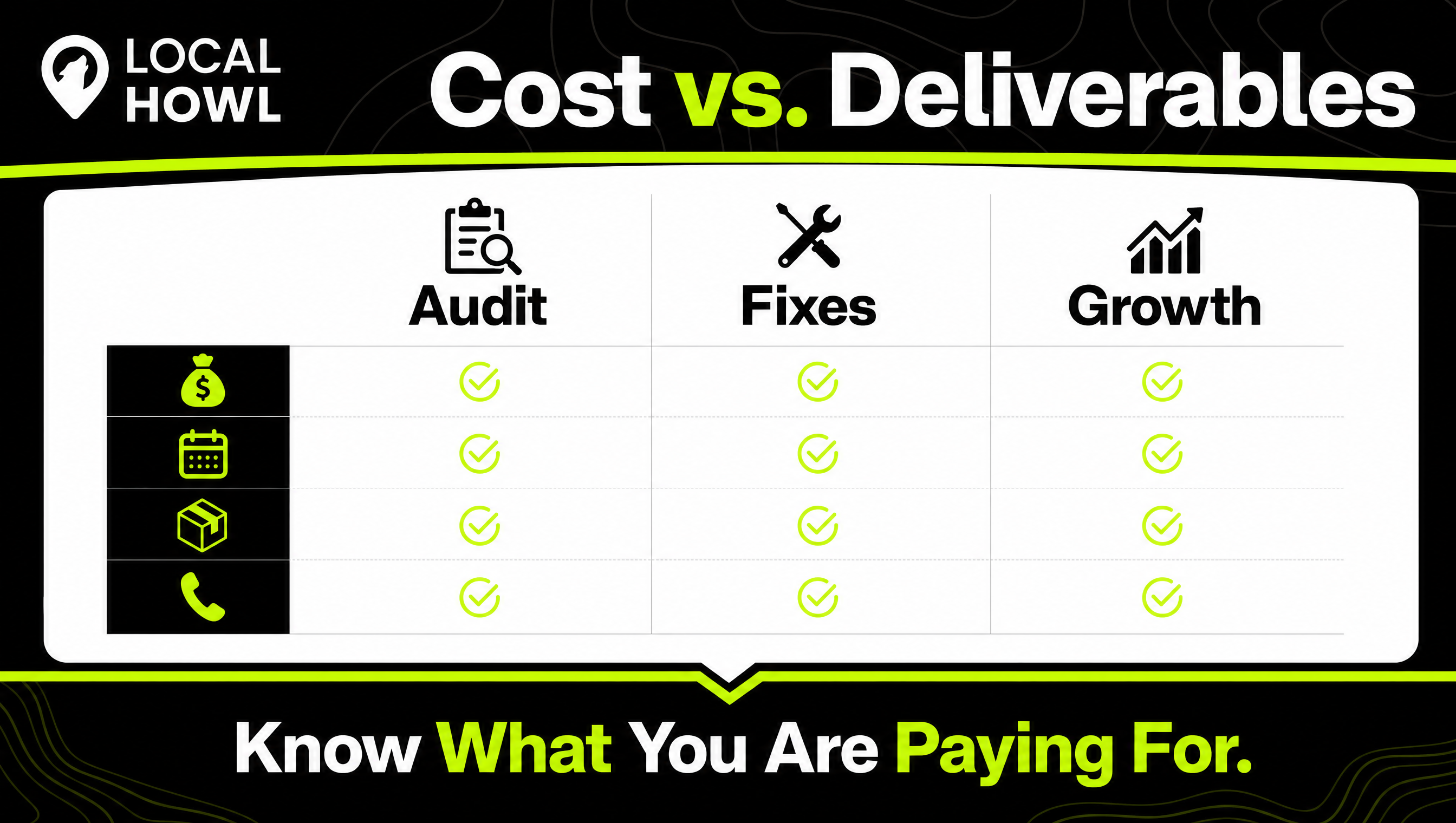
Pricing gut check: cheap Google Maps SEO is expensive if it never fixes the profile, citations, reviews, pages, or reporting. Higher-priced SEO is also a problem if the deliverables are vague. The cleanest question is: what exactly changes this month?
Red flags before hiring a Google Maps SEO company
The top-ranking pages in this market tend to promise speed, visibility, and lead growth. Those are attractive outcomes, but an SMB owner should be careful with any provider that skips the mechanics. You are not looking for magic. You are looking for a clear operating system.
Guaranteed top-three rankings
A provider can have a strong process. They can show past work, audits, tracking, and realistic timelines. But they cannot guarantee that Google will rank you in the top three for every search in every city. Google says local rankings are based on relevance, distance, and prominence, and distance is partly based on where the searcher is.
No map-grid or service-area reporting
For a service-area business, one ranking screenshot is weak evidence. You need to see visibility across your market. If a company only reports one location, you may miss the neighborhoods where competitors are winning calls.
Fake locations or keyword-stuffed profiles
Fake offices, virtual-office schemes, and keyword stuffing can create short-term noise and long-term risk. The better path is boring but durable: accurate profile data, real service-area proof, consistent listings, and pages that match actual services.
Content that never touches the money pages
Publishing generic articles every month can look like work, but it often misses the problem. For home-service companies, service pages, city relevance, GBP alignment, reviews, citations, and authority usually matter more than another random blog post.
What a map pack visibility audit should show
A good audit should make the opportunity obvious. It should show where you already have traction, where competitors control the map, and where you are close enough to push into the top three.
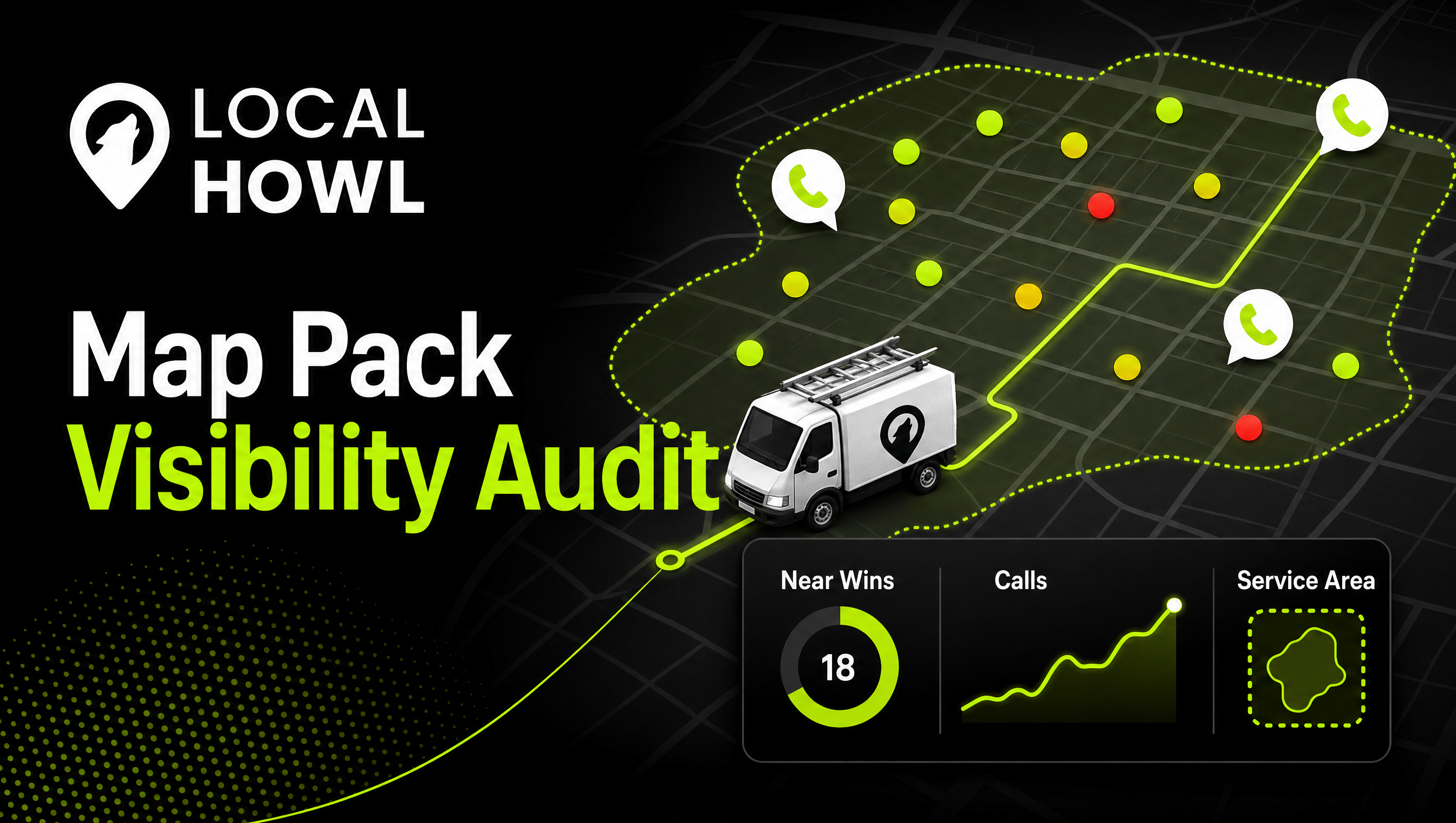
A real map pack grid shows who you compete with
The existing July 14 Houston foundation-repair example reports 47 businesses across the local boards, one competitor averaging a top-three position and six reaching at least 20% map coverage. These are historical scan observations, not Local Howl improvement results or customer counts. Read them with the limitations below before using the example to compare a market.
What to investigate: compare the exact query, search locations and competitor profiles, then check relevant website and listing evidence. Differences can help prioritize a review; this scan alone cannot establish which changes would improve a business’s rankings.

How to interpret this example
- Read the geography: each grid point represents a search location, not a customer or a lead. Results can differ across the same service area.
- Keep the denominator: coverage depends on the grid size, spacing, search term and ranking cutoff. Compare scans only when those settings match.
- Separate observation from cause: the visible competitors suggest what to investigate; the grid alone cannot prove which profile or website factor caused a position.
- Verify progress: repeat the same scan, retain dated exports and compare received inquiries separately. A single scan is not a before-and-after result.
Evidence limitation: the public example does not include the full query, grid settings or source export. Its summary cannot be independently reproduced from this page. It is not a before-and-after result, a measured increase in leads or a forecast for your business. A business-specific audit should retain the query, date, grid settings and original export.
What the first 90 days should look like
A 90-day Google Maps SEO plan should create clarity first, then fixes, then momentum. It should not start with random content or backlinks before anyone has checked the profile, citations, reviews, service pages, and ranking geography.
Days 1-15: Audit and baseline
Start with the free automated website report for an initial website check. A human local SEO review is separately scoped with your business and service-area details; it can cover your Google Business Profile, listings, competitors and Maps visibility. Confirm what will be reviewed before choosing ongoing work.
Days 16-30: Fix the obvious trust problems
Correct categories, services, service areas, photos, citations, duplicate listings, phone numbers, URLs, and profile details. Add missing conversion actions. Make sure calls, forms, and tracking are not broken.
Days 31-60: Strengthen relevance
Improve the service pages that support the searches you care about. A plumber might need drain cleaning, water heater, sewer repair, and emergency plumbing pages. An HVAC company might need AC repair, furnace repair, heat pump, maintenance, and installation pages. A roofer might need roof repair, roof replacement, storm damage, and inspection pages.
Days 61-90: Build momentum and measure the right things
Now the work should compound: review requests after completed jobs, owner responses, better photos, stronger internal links, authority signals, map-grid tracking, and reporting that shows where visibility is improving.
Swipe sideways to read all three columns.
| Timeframe | Focus | What the owner should see |
|---|---|---|
| Days 1-15 | Audit and baseline | Map visibility, competitor gaps, GBP issues, citation problems, service-page gaps, and tracking needs. |
| Days 16-30 | Core fixes | Updated GBP, corrected business data, priority listing fixes, and clearer conversion paths. |
| Days 31-60 | Relevance | Better service pages, internal links, FAQs, schema recommendations, and city/service proof. |
| Days 61-90 | Momentum | Review process, tracking reports, authority priorities, and a next-step plan based on rankings by area. |
When should an SMB hire for Google Maps SEO?
You should consider hiring help when the problem is not just one missing profile field. A lot of SMB owners can add photos, respond to reviews, and update business hours themselves. But if competitors are consistently outranking you across profitable service areas, the issue is usually bigger than one toggle.
Hiring makes sense when:
- You rank near your office but disappear in nearby cities you serve.
- Your profile is active but calls are flat.
- You have reviews but competitors with weaker businesses outrank you.
- Your citations are messy or duplicate listings keep showing up.
- Your website does not clearly support your highest-value services.
- You cannot tell which locations, services, or rankings are driving calls.
- You are comparing local SEO packages and need to know what is actually worth paying for.
If that sounds familiar, do not start by buying the biggest package. Start by seeing the map. A good audit should show what is missing, what is already working, and what should be fixed first.
FAQ
What are Google Maps SEO services?
Google Maps SEO services help a local business improve visibility in Google Maps and the Local Pack by optimizing its Google Business Profile, citations, reviews, service pages, local authority signals, and tracking.
How much do Google Maps SEO services cost?
Pricing depends on competition, locations, deliverables, and whether the work is audit-only or managed monthly. Local Howl's pricing page currently lists GBP Lite at $1,200 per month, billed annually. Check the current plan scope and billing terms before choosing a service.
How long does Google Maps SEO take for a home-service business?
Some fixes can improve visibility quickly, especially GBP, citation, or technical corrections. Stronger Maps visibility usually takes months because reviews, service-area proof, content, citations, and authority signals compound over time.
Can a service-area business rank in cities around its office?
Yes, but service-area businesses need real proof. Google still considers distance, so ranking across nearby cities usually requires accurate GBP settings, strong service pages, consistent citations, reviews from real jobs, and authority signals tied to the markets served.
What is the difference between Google Maps SEO and local SEO?
Google Maps SEO focuses on visibility in Google Maps and the Local Pack. Local SEO is broader and also includes organic website rankings, service pages, technical SEO, citations, reviews, local links, and conversion paths. A home-service business usually needs both.
What should I ask before hiring a Google Maps SEO company?
Ask what they will change on your Google Business Profile, how they handle citations and reviews, whether they track rankings across your service area, what service pages they will improve, what reports you will see, and how they define a qualified lead.
Want to know what is holding back your Google Maps visibility?
Start with the automated website report. For a human review of your Google Business Profile, listings, competitors and service-area visibility, share your business details with our team so we can confirm the scope and next steps.
Get a Free Local SEO Audit