Local SEO for home services is not just about understanding ranking factors. It is about turning those factors into calls, form fills, booked estimates, and profitable routes inside the cities and neighborhoods your crew can actually serve.
Broad ranking-factor guides are useful, but most home service owners do not need an academic list of every possible signal. A plumber, roofer, HVAC contractor, electrician, landscaper, or remodeler needs to know which signals help them show up when a nearby customer searches for emergency help, compares contractors, or looks for a trusted company in the Map Pack.
That is why this guide keeps the ranking factors tied to real home-service situations: service-area coverage, emergency searches, Google Business Profile accuracy, reviews, citations, local authority, and the difference between ranking near your office and ranking where your best customers actually live.
The short version: Google says local results are shaped by relevance, distance, and prominence. For home service businesses, that becomes a practical checklist: make your services clear, prove where you work, strengthen your Google Business Profile, build review and citation trust, and track rankings from the actual neighborhoods that create revenue.
Google's Local Search Algorithm for Home Services

Google describes local ranking around relevance, distance, and prominence. Home service companies need to translate those pillars into service-area proof, GBP accuracy, reviews, and authority.
Google's public guidance explains local ranking through three core ideas: relevance, distance, and prominence. Those ideas are simple, but the way they play out for service-area businesses is not always obvious.
Relevance
Relevance is how well your business matches what someone searched. If a homeowner searches for water heater repair, storm damage roofing, panel replacement, or AC repair, Google needs enough evidence to connect that search to your business. That evidence comes from your Google Business Profile categories and services, your website service pages, your review language, your internal links, and your local content.
Distance
Distance is how close the business is to the searcher or the searched location. A service-area business cannot move closer to every lead. What it can do is make its real service area clear, avoid fake locations, build location relevance with real service pages, and measure Map Pack visibility from multiple points across the area instead of only checking rankings from the office.
Prominence
Prominence is how known, trusted, and referenced the business appears to be. Reviews, links, citations, local mentions, brand searches, and third-party profiles all contribute to that trust picture. For home service companies, prominence is often the difference between being another listing and being the company people already recognize before they click.
How Home Service Businesses Should Read Ranking Factors
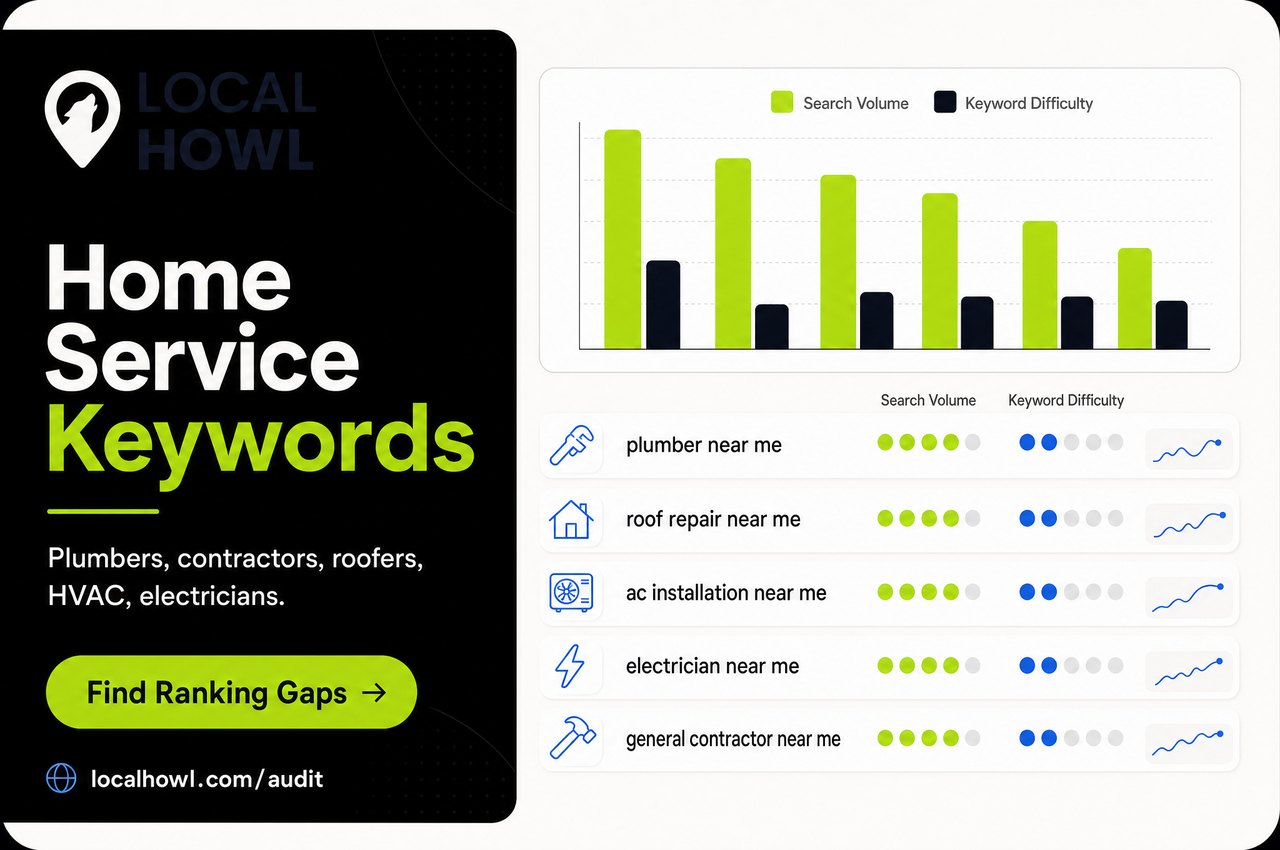
Ranking factors are easier to act on when they are connected to actual services, locations, and customer intent.
A ranking-factor list is useful only if it helps you decide what to fix first. For a home service company, that usually means separating Map Pack visibility from local organic visibility, then looking at the specific searches that create leads.
A plumber trying to rank for emergency drain cleaning, a roofer trying to show up after a storm, and an HVAC company trying to win AC repair calls all need the same fundamentals. But the way those fundamentals show up on the website, in the Google Business Profile, and in reviews will look different for each trade.
Home-service situation | Ranking factors to prioritize | Why it matters |
|---|---|---|
Emergency service calls | GBP categories, open hours, reviews, call buttons, service pages | Customers need help now and often choose from the Map Pack. |
High-value comparison searches | On-page depth, reviews, photos, local links, project proof | Roofing, remodeling, HVAC replacement, and electrical upgrades require more trust before the click. |
Service-area expansion | City pages, service-area proof, citations, Map Pack grid tracking | A business may rank near its office while missing nearby towns that produce profitable jobs. |
Trust recovery after messy listings | NAP consistency, duplicate cleanup, category cleanup, review response | Old listings and conflicting data can weaken confidence in the business. |
Local Search Ranking Factors: Grouped for Home Services
For home service owners, the ranking-factor conversation gets easier when the signals are grouped into practical buckets. BrightLocal's summary of the Whitespark 2026 Local Search Ranking Factors survey shows a clear split: the Map Pack leans heavily on Google Business Profile and reviews, while local organic visibility leans more on on-page content and links. That is why Google Map Pack ranking factors and local organic ranking factors should be reviewed separately before deciding what to fix first.
Local Pack / Maps Ranking Factors Grouped | Local Organic Ranking Factors Grouped |
|---|---|
1. Google Business Profile (32%) | 1. On-page (33%) |
2. Reviews (20%) | 2. Links (24%) |
3. On-page (15%) | 3. Behavioral (10%) |
4. Behavioral (9%) | 4. Personalization (8%) |
5. Links (8%) | 5. Google Business Profile (7%) |
6. Citations (6%) | 5. Citations (7%) |
6. Personalization (6%) | 7. Reviews (6%) |
7. Social (4%) | 8. Social (5%) |
Source: 2026 Whitespark Local Search Ranking Factors survey, summarized by BrightLocal. These percentages reflect participating experts’ estimates of relative importance. They are not published Google algorithm weights, measured causal effects or a forecast for your business.
Use the survey to prioritize investigation, not as a formula for more calls. For Maps, review profile accuracy, genuine reviews and useful service information; optimization cannot remove physical distance. For organic pages, review intent, substantive content, internal links and relevant references. Measure customer activity separately: the survey does not prove that increasing an interaction improves rankings.
Individual Local Ranking Factors Home Service Businesses Should Watch
There are more than 180 possible local ranking factors in the Whitespark survey, but most SMB owners do not need to chase every signal. These top individual factors are the ones a plumber, roofer, HVAC company, electrician, contractor, landscaper, or remodeler should understand first.
Local Pack / Maps Ranking Factors | Local Organic Ranking Factors |
|---|---|
1. Primary GBP category | 1. Dedicated page for each service |
2. Proximity of address to the point of search | 2. Geographic keyword relevance of content |
3. Keywords in GBP business title | 3. Quality and authority of inbound links to domain |
4. Physical address in the city of search | 4. Keywords in GBP landing page title tag |
5. Business is open at the time of search | 5. Inbound links from industry-relevant domains |
6. High Google star ratings | 6. Internal linking across website |
7. Address shows on GBP | 7. Relevant service keywords across website |
8. Additional GBP categories | 8. Keywords in GBP landing page headings |
9. Number of native Google reviews with text | 9. Website focuses on a specific niche |
10. Map pin properly placed | 10. Keywords in inbound link anchor text |
11. Recency of reviews | 11. Keywords in title tags across website |
12. Proximity of address to center | 12. Diversity of inbound links to domain |
13. Clickthrough rate from local search results | 13. Inbound links from locally relevant domains |
14. Steady growth of reviews over time | 14. Volume of quality content across website |
15. HTML NAP matching GBP NAP | 15. Keywords in headings across website |
This table is included for education and prioritization. For service-area businesses, some address-based factors may be less directly controllable, which makes category accuracy, service pages, reviews, citations, and tracking even more important.
What Each Individual Ranking Factor Group Means
On-page optimization
On-page optimization is the clearest path to relevance. A home service website should have a dedicated page for each important service, location-aware copy, strong title tags, descriptive headings, helpful internal links, image alt text, and schema that matches the visible content. This is what helps Google understand the difference between a company that generally says it does "home services" and a company that clearly offers drain cleaning, panel upgrades, roof repair, AC replacement, or remodeling in a specific service area.
More education: Improving On-page SEO for Local, Local Keyword Research, and Local Schema Templates.
Google Business Profile signals
For Map Pack visibility, the Google Business Profile is usually the highest-leverage asset. The primary category, secondary categories, services, business title accuracy, hours, photos, service areas, products, Q&A, and landing page all help Google understand when the company should show. A home service company should never stuff keywords into the business name unless those words are part of the real-world business name.
More education: Google's local ranking guidance, Google Business Profile education, Bing Places for Business, and NAP consistency.
Link signals
Links still matter because they help prove authority and relevance. For a home service business, the best links usually come from local organizations, sponsorships, suppliers, associations, chambers of commerce, neighborhood resources, industry sites, and useful content that earns mentions. A smaller number of relevant local links can be more valuable than a pile of generic, low-quality links.
More education: How to Do Effective Local Link Building and MozBar for checking link quality signals.
Review signals
Reviews influence both rankings and conversion. Star rating, review volume, review text, review freshness, review growth, and owner responses all help shape trust. For home services, the best review programs ask real customers for specific feedback after completed jobs, then respond like a real business instead of using canned replies everywhere.
More education: How to ask for reviews, Google Business Reviews, embedding reviews on a website, and review response templates.
Citation and listing signals
Citations are still useful because they reinforce the business's name, address, phone number, website, category, and service-area data across the web. They become especially important when a company has old addresses, duplicate listings, tracking numbers, or inconsistent NAP data from years of directory submissions.
More education: What Are Local Citations?, Citation Tracker education, and top instant-publish citation sites.
Behavioral signals
Local SEO surveys discuss behavioral signals such as clicks, calls, direction requests and time spent on pages. These are useful engagement observations, but this guide does not establish that each is a confirmed Google local ranking factor or that increasing one causes a ranking improvement. Make service information clear, keep mobile pages usable and track genuine customer actions. Do not buy clicks or simulate customer activity.
Personalization signals
Personalization changes search results based on where the searcher is, what they have searched before, and which businesses they seem to prefer. Home service companies cannot fully control personalization, so the practical move is to track rankings across the actual neighborhoods and ZIP codes that matter instead of judging visibility from one office location.
More education: Local Search Grid and Multilingual SEO for markets where language targeting matters.
Social signals
Social activity is rarely the first local SEO lever to pull, but it can support prominence. Active profiles, customer engagement, local proof, project photos, videos, and review activity can help a home service brand look more real and trusted across the web. For most service businesses, social should support proof and conversion rather than distract from GBP, reviews, service pages, and citations.
More education: Facebook reviews and recommendations and TikTok for local marketing.
1. On-Page Relevance: Show Google What You Actually Do
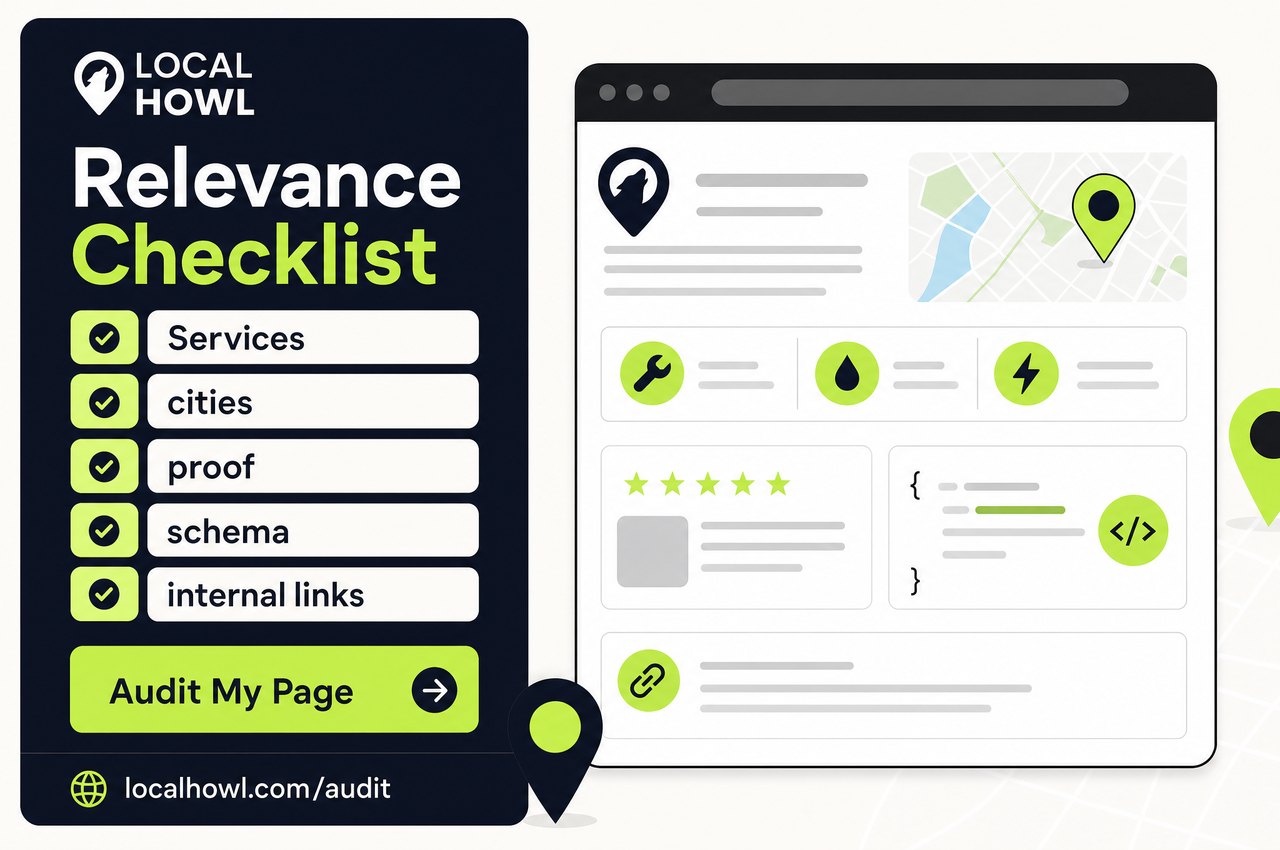
A home service page should make the service, city, proof, and next action obvious without repeating the same keyword until it sounds unnatural.
On-page relevance is where many home service websites lose the plot. They either create thin city pages with barely any unique value or bury their actual services under generic copy like "quality solutions for your needs." Neither approach helps a search engine or a homeowner understand why that company is the right result.
A strong service page should answer the basic local questions quickly: what service do you provide, where do you provide it, what problems do you solve, what proof do you have, and what should the visitor do next?
What to optimize
Title tag: Put the service and market naturally in the page title.
H1: Make the page topic obvious, such as "AC Repair in St. Louis" or "Roof Repair for Storm Damage."
Service copy: Explain symptoms, service types, common jobs, and what makes the crew qualified.
Local proof: Mention real service areas, project types, neighborhoods, photos, permits, warranties, or team details only when true.
Internal links: Link from related services, city pages, audit pages, and Google Business Profile resources with descriptive anchor text.
Schema: Add supported LocalBusiness, Service, FAQ, and Article schema where the visible page content backs it up.
Strong Local Keyword Research helps separate the searches that create calls from the searches that only create impressions. For service businesses, that means looking at service type, urgency, city, neighborhood, seasonality, and problem language.
2. Google Business Profile Signals: Make the Map Pack Trust You
Your Google Business Profile is one of the clearest local relevance signals you control. For a home service company, that means choosing accurate primary and secondary categories, building out services, adding real photos, answering questions, earning reviews, and making it easy for customers to call.
This is where Google Business Profile optimization services matter. A profile can look complete on the surface while still missing the signals that connect it to high-value searches.
Profile details that matter
Primary category: Choose the most specific available category that accurately describes the business as a whole.
Additional categories: Use relevant categories without drifting into services you do not actually perform.
Services: Add clear service names that match the website and real customer jobs.
Photos: Use real team, vehicle, equipment, project, and location photos when available.
Reviews: Ask for reviews consistently and respond with useful, human replies.
Conversion paths: Check the phone number, website link and supported booking options. Verify service-area settings and use only contact features currently available for your business.
Do not create fake locations. Service-area businesses should not use fake storefronts, rented mailboxes, or addresses that do not represent a real eligible location. That can create trust and compliance problems instead of sustainable rankings.
3. Reviews and Prominence: Build Trust Before the Click
Reviews are not just a conversion layer. They help describe what your company does, which jobs customers trust you with, where you work, and how recently people have chosen you. For a home service company, review content often contains the exact language future customers use when they search.
The goal is not to game reviews. The goal is to build a real review system: ask at the right moment, make it easy, respond to customers, and look for repeated service themes that should also appear on the website.
A structured Online Reputation Management process helps turn review requests, responses, and review themes into a steady trust signal instead of a once-in-a-while task.
Prominence also includes authority
Prominence grows when reputable websites, directories, local organizations, suppliers, sponsorship pages, associations, and press mentions connect your brand to the services and locations you actually serve. That is why Local Authority Building should support the article's prominence section.
4. Citation Consistency: Stop Confusing Search Engines
Citations are business mentions across directories, maps, local platforms, industry sites, and data aggregators. For home service businesses, citations can get messy fast: old phone numbers, moved offices, duplicate profiles, outdated service names, and inconsistent URLs all create friction.
This is not always the highest-impact lever, but it is often a low-hanging fix. A local SEO citation audit can show where the business has conflicting data, and business listings and local citations work can help clean up the trust signals around the company.
What to check in a citation audit
Business name formatting
Primary phone number
Website URL
Real address or service-area settings
Duplicate listings
Wrong categories
Closed or moved locations
Major directories and industry-specific directories
5. Map Pack Gaps: Track the Places That Create Calls

A single rank check from your office can hide the neighborhoods where competitors are taking calls.
A home service company does not rank the same everywhere. You might show up near your office, disappear five miles away, and lose the suburbs where your best jobs happen. That is why a practical home-service ranking-factor strategy needs Map Pack tracking by location, not only a generic keyword ranking report.
A local SEO competitor analysis compares where businesses appear for defined searches and records relevant profile, page and listing differences. Those observations guide investigation; they do not establish which differences caused a ranking.
What to compare against competitors
Primary and secondary GBP categories
Review volume, review velocity, and review themes
Service page depth and city relevance
Citation consistency and duplicate listings
Local backlinks and community mentions
Map Pack visibility across target ZIP codes and neighborhoods
After the gaps are clear, local SEO tracking and reporting keeps the strategy honest. You should be able to see whether visibility is expanding across the service area and whether that visibility is turning into calls or booked work.
How Ranking Factors Change by Home Service Category
These are illustrative trade examples, not client results or proof of ranking gains.
Plumbers
Local SEO for plumbers should emphasize emergency service, water heater repair, drain cleaning, leak detection, service-area coverage, and review language tied to fast response. This keyword is commercially attractive because plumbing searches often happen when the homeowner needs help now.
Electricians
Local SEO for electricians should focus on panel upgrades, repairs, EV charger installation, inspections, emergency calls, and proof that the company serves the searched city legally and reliably.
Roofers
Local SEO for roofers should connect storm damage, roof repair, replacement, insurance-related searches, and service-area proof. Roofing pages need trust signals because the job size is larger and customers compare more carefully.
HVAC companies
Local SEO services for HVAC contractors should separate repair, replacement, maintenance, AC, furnace, heat pump, and emergency search intent. Seasonal visibility matters, so content and GBP updates should be planned before demand spikes.
Contractors and remodelers
Local SEO for contractors and remodeling companies should show proof of project types, service area, specialties, licensing where applicable, and photo evidence. These searches are not always urgent, so authority and trust content matter more.
A Practical 30-Day Action Plan
Start with a website report: The free automated website report checks the website. Human reviews of GBP, citations, reviews, Maps visibility and competitors are separately scoped. Confirm coverage before choosing implementation work.
Fix GBP relevance: Tighten categories, services, photos, service areas, and conversion paths.
Improve the top service pages: Add real service detail, internal links, FAQs, schema, proof, and clearer CTAs.
Clean up citations: Correct NAP issues, duplicates, and outdated listings.
Build review momentum: Add a repeatable ask-and-response process after completed jobs.
Map competitor gaps: Track visibility from the neighborhoods and ZIP codes that create real revenue.
Improve pages for services you actually provide: Explain the specific work, service area, real project evidence, common questions and next step. A plumbing business might improve drain-cleaning or water-heater pages; an HVAC business might improve repair or installation pages. Do not publish pages for trades you do not serve or near-identical city pages with no distinct customer value.
FAQ
What local ranking factor should a home service business fix first?
Start with the factor that is most obviously blocking visibility or trust. For many home service businesses, that means fixing Google Business Profile categories and services, improving the main service pages, cleaning up citations, and building a steadier review process before chasing advanced tactics.
How do you rank higher in Google Maps for home services?
To rank higher in Google Maps, improve the signals that affect Map Pack visibility: accurate GBP categories, clear services, real photos, consistent reviews, correct service-area settings, clean citations, useful service pages, and local authority. Then track rankings from the neighborhoods and ZIP codes where customers actually search.
Are Map Pack rankings and organic rankings affected by the same factors?
They overlap, but they are not identical. Google describes local results through relevance, distance and prominence. The expert survey discussed here assigns different estimated importance to Maps and organic signal groups. Those estimates are not published algorithm weights and do not prove that an individual behavior causes higher rankings. Compare dated page or profile evidence before choosing work.
Can a service-area business rank without showing its address?
Yes, but the business still needs real-world trust signals. Service-area businesses should keep their Google Business Profile accurate, use real service areas, avoid fake locations, build strong service and city relevance on the website, earn reviews, and keep listings consistent.
How long does local SEO take for home service companies?
Simple fixes like GBP updates, citation cleanup, and page improvements can help quickly, but stronger local visibility usually takes months of consistent work. Reviews, content, links, and service-area authority build over time.
Sources and methodology: This article uses Google's public local ranking guidance and the 2026 Whitespark Local Search Ranking Factors survey, also summarized by BrightLocal. Survey percentages are participating experts' estimates, not published Google algorithm weights or measured causal effects. Use them to prioritize investigation, then verify findings against your business, dated search results and received inquiries. Google identifies relevance, distance and prominence as the main local ranking considerations. For a business-specific comparison, record the query, search location or grid settings, device, check date and source export. Keep implementation records separate from visibility and qualified requests.
Primary external source: Google Business Profile Help: Improve your local ranking on Google.
Ranking-factor source: Whitespark Local Search Ranking Factors and BrightLocal's local ranking factors guide.
Want to see which ranking factors are holding your home service business back?
Our Google Maps SEO services for home-service businesses explain the implementation work and scope to agree. The free automated website report is an initial website check, not a complete Maps or citation audit. Ask separately about a human local visibility review and confirm what is included.