
Start here: Useful backlink research starts with the websites and pages linking to your business. Domain Authority and similar scores are third-party estimates. Review relevance, the reason for the link and any paid arrangement before choosing opportunities or making changes.
LOOK AT THE EXAMPLE
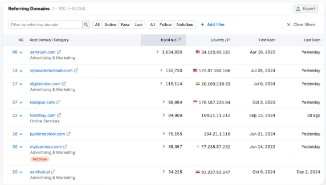
Semrush’s manual uses this table to show individual referring domains. Read a source domain and the number of links it sends, then open the actual page. This is the tool publisher’s example, separate from our anonymized roofing audit below.
Read the report guideWhat Domain Authority measures
Domain Authority is a third-party metric developed by Moz. It is not a Google ranking score, an approval from Google or a target that guarantees visibility. Different tools calculate their own authority metrics using different data and methods.
What to review instead of a score alone: Is the referring page relevant to the business or its customers? Does a reader have a genuine reason to follow the link? Is the link part of a link network, an exchange or an automated scheme? Use a score, if available, as one comparison input, not as the objective of a link campaign. Evaluate the referring page’s purpose and quality alongside the business’s content, competition and search performance. A higher third-party score alone does not establish that a business will outrank its competitors. Our authority building work starts from those questions.
FROM OUR RESEARCH
Check the websites behind the backlink count
All three figures came from one anonymized roofing audit. Many links can come from the same website. We inspect the sites and pages behind the total before recommending links that make sense for your business.
Stored Semrush overview in Howl IQ, November 12, 2026. One anonymized roofing audit. How we checked the data
How to read this example

When link problems need investigation
A third-party toxicity label does not prove Google has penalized a site. Google says most sites do not need its disavow tool and warns that incorrect use can harm search performance. Investigate the actual links and their history before recommending removal or disavow.
Investigate substantial artificial or manipulative links, especially if the business or a former provider arranged them. Examples that warrant review include link networks, bulk automated placements and exchanges intended to manipulate search results. An unfamiliar domain, foreign location or low tool score alone does not prove a link is harmful.
Google’s disavow guidance applies when a considerable number of spammy, artificial or low-quality links has caused, or is likely to cause, a manual action. In that situation, first try to remove the problematic links. Consider disavow only after a qualified review of the evidence and prior actions.
Do not submit a disavow file simply because a tool assigns a high toxicity score or an unfamiliar website links to you. Record the referring page, action history, any relevant Search Console manual-action evidence and the reason for each proposed removal. Routine score-based disavow is not part of a responsible default link-maintenance process.
Local link building: finding relevant references
Useful references can come from legitimate local organizations, industry resources, partners and publishers. Start with a resource or business contribution worth referencing, then approach a relevant person with a specific reason it helps their audience.
Research and individual outreach
Check the organization’s audience, existing resource and editorial requirements. Explain what your contribution adds without requiring a particular anchor phrase or promising a ranking result. Keep a record of the source, contact, response and placement status.
Review a small set of relevant opportunities individually. A publisher may decline, request changes or choose not to link, so no single placement is guaranteed, and outreach volume does not guarantee rankings. Follow up appropriately and record what was actually published, including the destination and any sponsorship qualification.
What makes a backlink valuable?
A useful reference should make sense without looking at its authority score. Review whether it serves a relevant audience or subject, has useful surrounding content, identifies sponsorship where applicable, and presents accurate business information.
Relevance
Does the site relate to your industry or location?
Page quality
Is the reference useful on a page people actually read? Scores are not Google’s approval.
Diversity
Are you building links from different sources, not just repeats?
Practices to avoid
Avoid link networks, bulk automated placements, irrelevant exchanges and keyword-stuffed links distributed across unrelated sites. Qualify paid promotions appropriately. Evaluate the actual page and its purpose; a foreign domain, a low traffic estimate or a sidebar location alone does not establish harm or justify disavow.
Does authority help you get cited in AI search?
Possibly, though the evidence is thin. In one test, Semrush published 81 new FAQ-style pages on its own blog, a site with a Semrush Authority Score of 84, and tracked for 30 days when Google’s AI Mode and ChatGPT Search cited them:
- Google AI Mode: 29 of the 81 pages were cited in the first 24 hours and more than half by the end of the first week, then citations fell back to 21 pages by day 30.
- ChatGPT Search: 8 pages were cited right after publishing, growing steadily to 34 by day 30.
Semrush suggests its strong domain authority could explain how quickly Google AI Mode picked the pages up; ChatGPT Search was slower. That is one site’s test and its own interpretation, not proof that a third-party score causes AI citations. The practical takeaway matches the rest of this guide: publish helpful, well-structured content, keep the site technically sound and easy to crawl, build credible references, and keep your Google Business Profile up to date. For more on AI search, read what Google AI Mode means for your business, or see how we approach AI search visibility for local businesses.
Our backlink strategy at Local Howl
Begin with the site’s existing references and the actual sources that appear relevant to its industry or community. A documented prospect list should explain why each source matters, what resource could help its readers and what outreach or verification remains pending. See how we evaluate sites, and what each plan includes, in local link building services. Technical SEO and on-page work have separate roles; a link campaign is not a substitute for a usable, relevant website.
On GBP Basic+ we deliver 2 high-authority (DA 20+) backlinks a month, and on Local Growth Standard 4; compare every plan on our pricing page. They are placements on relevant DA 20+ sites. DA is a third-party score, and DA 20+ describes the linking sites, not a promise about your own score or rankings.
Authority scores: limits to remember
Different tools use different proprietary methods and link indexes. A score is not a Google ranking target or a promised business result. Compare relevant sources and measured search outcomes, not score changes alone. Unfamiliar links or a toxicity flag do not automatically justify disavow.
What to include in a backlink review
If you need help, start with a scoped review of relevant sources, existing link history and the resources your business can genuinely contribute. The next step should be based on evidence, not a promised authority score.
Review sources before choosing link opportunities
Separate links from referring websites.
Open your available backlink report and group links by the website they come from. The roofing audit above records 7,858 backlinks from 103 referring websites and a Semrush Authority Score of 6 out of 100. Many links can come from one site, so the backlink total does not describe thousands of independent recommendations. Those figures also do not establish that the links are harmful or explain the business’s rankings.
Open the pages behind the numbers.
Inspect the actual page, destination and surrounding text. Ask whether the source relates to your location, trade or customers and why someone would follow the link. Check that the destination is useful and the business details are accurate. Record anything you need to investigate, including a paid arrangement or an old campaign. A low score or unfamiliar domain alone is not enough reason to request removal.
Start with relationships you can substantiate.
Look at suppliers, manufacturers, trade groups, local organizations and community activities the business already has a connection to. A supplier’s installer directory may be worth checking if you actually qualify. Record its requirements and the contact or application process before approaching it. Send a specific, accurate explanation of the relationship or resource you can contribute. The organization decides whether to list or reference you.
Check the arrangement and the published result.
If payment or sponsorship is involved, review how the link will be identified. Google’s link-spam policy covers buying links for ranking manipulation; appropriately qualified advertising and sponsorship links are allowed. Save the contact history and inspect any published placement, including where it points. Report outreach, live links and search performance separately. Ask for a qualified review before proposing removals or disavow work based on a tool’s warnings.
What it actually takes to do this yourself
You’ll need to inspect the linking sites, research relevant opportunities and keep track of outreach.
- Tools
- A backlink index for research, plus the site’s Search Console links report where available.
- Access
- Business and website details for outreach, plus contacts at relevant organizations where available.
- Know-how
- Telling a useful link from a risky one. Knowing Google’s link spam policies.
- Upkeep
- Following up on outreach, recording replies and checking any published links.
Where owners get stuck
- Prioritizing a third-party score over relevant linking websites.
- Buying a package without checking the sites and link arrangements.
- Sending outreach without a relevant reason for the organization to respond.
- Assuming an unfamiliar backlink is harmful before reviewing it.
How Local Howl can help
Your program sets the scope. We’ll agree on who handles each task and how we’ll report it.
DO IT YOURSELF
You can identify suppliers, associations and local organizations connected to your business, check their listing requirements and make a straightforward introduction. Keep a list of the pages you review and any replies. You do not need an authority-score target to recognize whether a reference makes sense for your customers.
- Review your current links
- Study relevant competitor mentions
- Research local and industry opportunities
- Contact the organizations and follow up
- Check any proposed arrangement against the link-spam rules
We can do the research and follow-through, with a clear reason for each opportunity we recommend.
WITH LOCAL HOWL
A package promising hundreds of links tells you very little about where those links will come from. We inspect current sources and research relevant local or industry opportunities before recommending outreach. Where your program includes it, we manage that outreach and check the published links. Your real business relationships give us a useful starting point.
- We review your existing links and referring websites
- We research relevant local and industry opportunities
- We handle outreach included in the agreed scope
- We explain the relevance and risks before recommending the next step
Guidance checked November 18, 2026. Read the source: